SIMONE WADDELL’S NEW ALBUM UNFORGETTABLE


This is the sixth album from the Australian jazz singer & songwriter SimoneWaddell. I was very impressed by her previous album The Art of Collaboration, which I reviewed for The Australian in June, 2022, giving it four-and-a-half stars. I then wrote: “A gorgeous singer, her talent of Kate Ceberano proportions, Waddell moves effortlessly between jazz, soul and pop genres.” Today I’d stick by what I said then, although her Unforgettable album takes her very much into different territory.
The new album has ten tracks, featuring what Waddell describes as “timeless songs from the Great American Songbook that have been a joy to sing. Some I’ve been singing for years…” When I first heard the album I initially thought it was a risky venture. Admittedly this turned out to be a very minor reservation, as the more I got into the album, the more that feeling faded from view. But as a reviewer I feel a responsibility to mention it here and now, if only because this admission might serve to warn other potential listeners to be wary of the same feeling. Anyway, why do I say this? Revisiting an array of iconic past hits from major artists carries the possibility that those who loved the originals may feel a resistance towards the new versions. Sometimes the originals are so close to perfect, and so entrenched in the collective memory, that the new redefinitions might suffer by comparison.

To illustrate my point, take for example Billy Joel’s Just The Way You Are. The original, with the memorable solo from the American altoist Phil Woods, is so good that a new version needs to convincingly add to the work. (More on this below). Similarly one might ask, in the case of such classics as Paul Simon’s Still Crazy After All These Years, and the title track Nat King Cole’s Unforgettable, has Waddell successfully breathed new life into such compositions? Of course, this may depend on how well-known a particular composition is. The risk is of course somewhat lessened in the case of those tunes which are a little more obscure, and not so well known.
One example of the not so well-known might be Michel Legrand’s How Do You Keep The Music Playing? This tune was not uppermost in my mind until I heard Waddell sing it, but I now know, courtesy of this album, that it’s a beautiful work. Otherwise, Waddell is on solid ground in presenting not merely one, but four compositions by this prolific French composer, the others being Windmills of Your Mind, Watch What Happens, and What Are You Doing the Rest of Your Life? Legrand has a happy knack of writing songs which have lasting value; one rarely tires of them. So, in this respect, Waddell is certainly on a winner.
Before embarking further, let’s document who’s playing on the album. As she did with The Art of Collaboration, Waddell has enlisted a formidable array of musicians to accompany her in the studio: pianist Paul Grabowsky; double bassist Philip Rex; drummer David Jones; guitarists James Muller, Jack Pantazis, Paul Mason & Damien Cooper; flugelhorn/trumpeters Nadje Noordhuis, Marcus Printup & Warwick Alder; vocalists Gregg Arthur, Doug Williams, and Mary Kiani (plus Mary’s students and friends); organist Michael Tan; and percussionist Tony Azzopardi.
With this sort of extravagant musical expertise on tap, one might expect a product of the first order and, in my view, this is certainly what Waddell has achieved. I trust that what I write below will make this clear. All the arrangements have been written by the legendary guitarist Jim Kelly, with the exception of one arranged by Waddell herself, the title track Unforgettable, which is the final track on the album. It has Waddell accompanied by two musicians only: Grabowsky on piano, and the brilliant Nadje Noordhuis on flugelhorn. Noordhuis provides a counter-melody to the vocal throughout and plays a lovely solo, enabling the album to close on a highly memorable note.

Let’s return to Just The Way You Are, which I mentioned earlier. Waddell’s version, which opens the album, begins with a strong bass figure from Rex under Waddell’s vocal, until she enters, and the vocalist Gregg Arthur comes in. Singing down in his lower register, as the chosen key suits a female vocalist, Arthur’s voice is initially somewhat unrecognisable. Still, with his customary aplomb, Arthur sounds very good sharing some of the lyrics with Waddell, and then the track really comes alive when they sing together, providing rich harmonies. Not only that, the track also features spirited solos from trumpeter Warwick Alder and from Grabowsky on piano. I therefore conclude that Waddell’s version of this great song does enough to effectively redefine it. It’s no longer a Billy Joel song; now it’s owned by Waddell.

I feel much the same way about How Do You Keep The Music Playing? the other tune on the album with a second vocalist. Waddell begins with the first few bars accompanied by Grabowsky, then a lovely phrase from the brilliant US trumpeter Marcus Printup brings in the band, featuring the Sydney-based singer Doug Williams, who now takes on the vocal. As with Just The Way You Are, Waddell and Williams combine beautifully, with Printup providing lovely phrases filling in the gaps between the vocal lines. A very moving version, it ends with a cadenza featuring Printup, Waddell and Williams improvising with each other. Very much a highlight of the album.
In many ways, the album is dominated by two multi-talented musicians. Firstly, the dependable Paul Grabowsky, who plays on all ten tracks; his piano solos and inspired comping give the album real distinction. Secondly, the ARIA award-winning Michael Tan who mixed, mastered, recorded and produced all vocals, as well as contributing musically on organ and guitar. Waddell describes Tan as “a true anchor”.
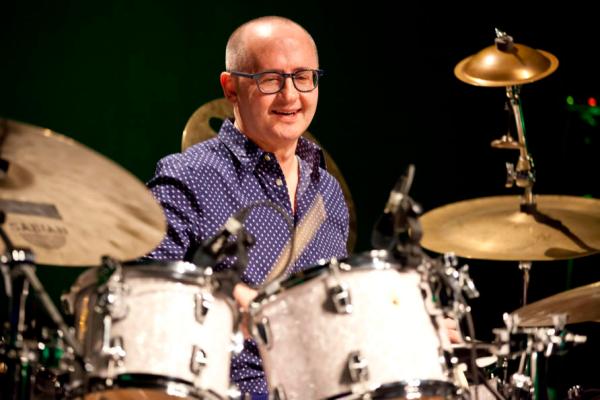
Overall, all tracks are relatively full-blooded versions, compared to the originals, which are generally softer and less questing. One can only assume that the players in the rhythm section in particular were encouraged by Waddell to go for it in the studio. As always in jazz the essential character of the music comes from the drums, so the impeccable nature of the music can largely be put down to the playing of the legendary David Jones.
If there’s one thing that’s distinctive about Jim Kelly’s arrangements it’s their rhythmic sophistication. I assume that he’s primarily responsible for the fact that the time-feels are more rock-oriented than we might have expected. That’s one reason why Waddell’s versions sound very modern & contemporary, and are not pale imitations of the originals. The Way We Were, for example, has a nuanced soft-funk feel, on which Jones uses brushes, rather than the more traditional straight-ahead eight-feel. Paul Simon’s classic Bridge Over Troubled Water ups the ante to a more full-blooded funk time-feel, this time with Jones using sticks.
This is overwhelmingly an album of very powerful tracks. I concede that initially my appreciation of Waddell’s repertoire was too coloured by my familiarity with the well-known past versions. The more I listened to the album the more I found Waddell’s versions infectious and compelling; in other words, Waddell’s artistry drew me in, so I was very happy to find myself on her wave-length.
There’s not much more to say, except to document the one composition I haven’t yet mentioned, the Hal David/Burt Bacharach classic What The World Needs Now is Love. Yes, in 2026, it certainly does. Wikipedia tells us that this composition “is considered one of the most important and enduring pop compositions of the 20th century. It is hailed for its timeless message of unity, its sophisticated musical structure, and its function as a gentle yet potent anthem for peace”. As a matter of interest I once had a unique opportunity to interview David when he visited Sydney as a guest of APRA; he was a lovely man, and I was glad to tell him that I felt he was one of the most perceptive lyricists in the history of songwriting.
I’d like to end by quoting Waddell’s testimony about the repertoire on this album: “At this stage of life, these songs speak differently to me – perhaps more deeply, more truthfully and with greater tenderness than before. These are all classic songs that can accompany us through a lifetime, to surface in memory, in longing, in gratitude, and with reminders along the way. I wanted to create something timeless and elegant, with excellent musicianship, iconic pieces and pure melodies.”
Waddell has stressed in email correspondence her quest to find what she describes as “a deeper emotional relationship with these songs at this stage of life, rather than approaching them simply as reinterpretations of familiar standards.” This is a noble mission which personally I warmly welcome. Not a day goes by without my feeling grateful that I can still learn more about the compositions in the Great American Songbook, and feel appreciative that the works by so many great composers are still being explored by leading musicians such as Simone Waddell and her colleagues. I believe that exploration is indispensable; it still provides, for me anyway, the essential language of jazz.


.png)